


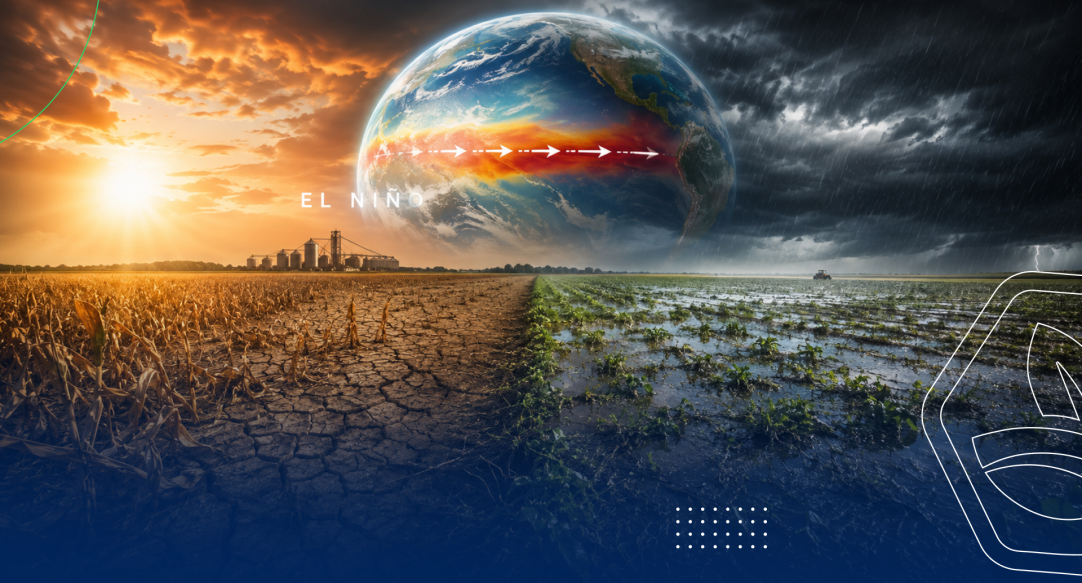
The possibility of a historically intense El Niño between October and December 2026 has raised the level of attention regarding the impacts the phenomenon could have on global climate. According to NOAA, there is a 90% chance of a very strong El Niño and a 69% probability that the event will reach historical intensity, exceeding records observed since 1950.
For agribusiness, the alert goes beyond the forecast of higher temperatures. Changes in atmospheric circulation can alter rainfall and temperature patterns across different regions, increasing the likelihood of adverse weather conditions. In Brazil, projections indicate significant differences between regions, reinforcing the need to monitor the evolution of the phenomenon.
What makes this El Niño different
The current concern is related not only to the formation of the phenomenon, but also to the intensity it may reach. Equatorial Pacific waters are already more than 2°C above average, and models point to a scenario that could become exceptional in the coming months.
Key points of attention include:
- Changes in rainfall patterns;
- Temperature fluctuations;
- Increased occurrence of extreme weather events;
- Different impacts across producing regions;
- Greater uncertainty for agricultural planning.
Climate can change the crop season scenario
In the field, changes in weather patterns can directly affect crop development. Excess or insufficient rainfall, above-average temperatures, and prolonged periods of stress can alter yield potential even when management has been planned for normal conditions.
These impacts can occur at different stages of the crop cycle:
- Crop establishment;
- Vegetative development;
- Flowering and grain formation;
- Production quality;
- Final yield.
Therefore, climate risk needs to be analyzed as part of the planning process, rather than simply treated as a variable to be monitored after problems arise.
Brazil will face different challenges across regions
The effects of El Niño do not occur in the same way throughout Brazil. Projections cited by UOL indicate the possibility of above-average rainfall in the South, while parts of the North and Northeast may experience below-normal precipitation. Above-average temperatures are also expected across much of the country.
This regional difference makes planning even more important. For producers, monitoring weather conditions means understanding how the scenario may specifically affect their region and adapting decisions as forecasts evolve.
Read also: ANDA 2026: the event connecting the Fertilizer Market to the future of agribusiness.
Anticipation is gaining ground in agricultural planning
It is still not possible to determine exactly what the phenomenon’s peak intensity will be. Therefore, rather than relying on a definitive forecast, the current situation requires continuous monitoring and preparation for different scenarios. The meteorological community itself highlights the importance of advance forecasts and alert systems to reduce impacts.
In practice, this means considering:
- Climate scenarios in planning;
- Greater attention to regional conditions;
- Monitoring throughout the crop cycle;
- Strategies capable of reducing production vulnerability.
Efficiency also depends on the ability to respond
When the environment becomes more challenging, productivity depends not only on the crop’s potential, but also on its ability to respond to stress. Management practices need to seek conditions that support development and the efficient use of available resources, especially in the face of greater climate variability.
This scenario reinforces an important shift in agribusiness: efficiency does not simply mean producing more under ideal conditions. It also means building production systems that are better prepared to respond when the environment becomes unpredictable.
Conclusion
The possibility of a historically intense El Niño places agribusiness in another scenario of climate uncertainty. With NOAA pointing to a 69% chance of a historical event between October and December, monitoring becomes even more important.
Climate will remain a variable that producers cannot control. However, the ability to anticipate scenarios, adjust strategies, and strengthen crop responses can make a difference. In agriculture, preparing for variability is also a way to protect productivity.