


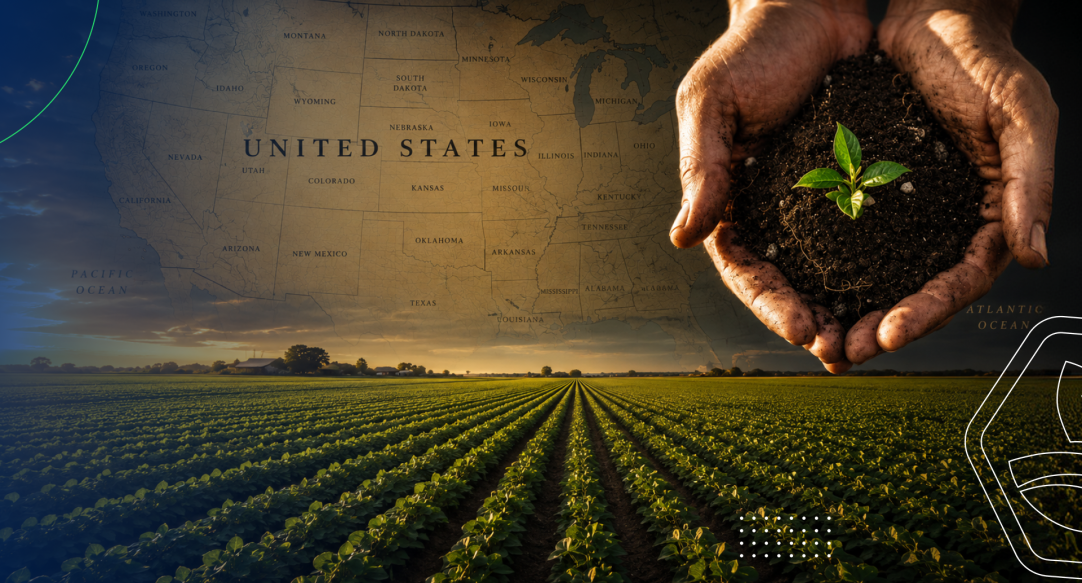
The announcement of a $500 million investment by the United States government in domestic fertilizer production reveals a significant shift in the global landscape. Beyond merely expanding production capacity, this move demonstrates that agricultural inputs have come to play a strategic role in food security.
This repositioning is no coincidence. Geopolitical instability and the impacts on global supply chains highlight the risks associated with relying on a limited number of international suppliers to sustain agricultural production.
Geopolitics directly influences on-farm costs
In recent years, trade conflicts and tensions have directly affected access to fertilizers. Countries heavily dependent on imports face rising costs and supply uncertainty.
This scenario directly impacts the agricultural sector because:
- Fertilizers account for a significant portion of production costs;
- Supply fluctuations affect crop planning;
- Price volatility reduces predictability.
In other words, geopolitical decisions have come to influence outcomes at the farm level.
Global dependence has become a strategic risk
The concentration of fertilizer production in a few countries has exposed a significant fragility in the global agricultural supply chain. When disruptions occur, the impact spreads rapidly across different markets.
This leads to consequences such as input shortages at critical times, widespread price increases, pressure on productivity, and risks to food supplies; consequently, what was once viewed as global efficiency is now seen as a vulnerability.
Countries are beginning to strengthen their domestic supply chains
Against this backdrop, U.S. investment follows a broader trend: countries seeking greater autonomy in the production of strategic inputs. The goal is to mitigate external risks and increase control over the supply chain.
This move entails incentivizing local production, diversifying suppliers, reducing reliance on international sources, and enhancing supply security; in practice, it involves transforming fertilizers into a strategic national asset.
Direct impacts on agribusiness
This repositioning directly affects global agricultural dynamics. With increased domestic production, countries tend to gain greater stability and predictability, while dependent markets become more exposed.
Key impacts include:
- Changes in price formation;
- Reconfiguration of international trade;
- Increased competitiveness for domestic producers;
- Greater security in agricultural production.
Access to inputs becomes a competitive advantage.
Conclusion
U.S. investment reinforces a key point: fertilizers have shifted from being merely an operational input to becoming a strategic element of global agribusiness.

And in this new landscape, success goes not just to those who produce the most, but to those who secure stable access to the resources underpinning production.